Hive covers the entire software development lifecycle.
Writing the code is just one step. Hive also sets up the machines, follows your standards, verifies each change, and runs a review before the work reaches you.
Plan
You set a goal. Hive plans the work.
Build
Hive puts your agents to work, each on its own machine, even when your laptop is closed.
Verify
Hive tests each change and records the running app.
Ship
You review Hive’s report and merge when ready.
Watch
Hive watches production. One click from you puts an agent on any issue.
Repeat
Over time, Hive suggests workflow improvements and takes on whatever you hand off.
Every task runs on its own machine.
Start one task or twenty. Each gets a machine in Hive Cloud that starts in under a second and grows when it needs more resources. Agents pause when idle and pick up where they left off when you return.
Paginate the orders endpoint
RunningStarted in 0.65 seconds. Pauses after 15 minutes idle.
Every agent follows the same guardrails.
Hive sets your repository up with modern guardrails and practices for agentic engineering, so every agent builds the same way and builds it right.
Add Hive practices #412
.hive/practices.json +38
AGENTS.md +24 −2
scripts/precheck +61
docs/LESSONS.md +12
Includes practices for evidence, testing in the real app, code review rules, and lessons learned.
Hive shows its work.
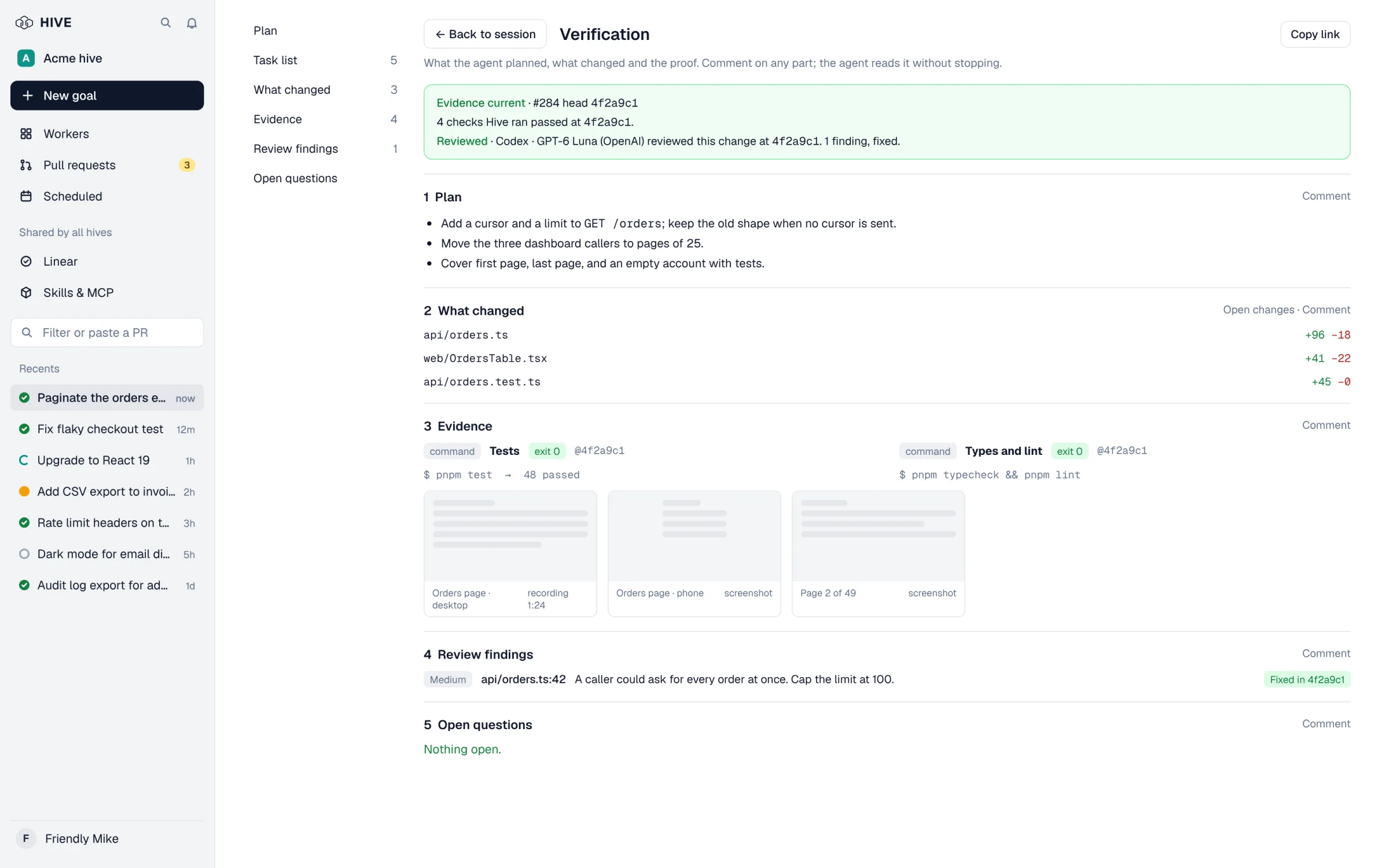
Every change comes with a plan, a diff, tests, and a recording of the running app. Hive runs the checks itself, so you don’t have to take an agent’s word for it.
A second agent reviews every change.
Models miss their own mistakes, just like people do. So when Claude writes the code, a model from another lab reviews it line by line before it ever reaches you.
Written by Claude Code. Reviewed by Codex.
41 const page = await db.orders.list({
42 − limit: req.query.limit,
42 + limit: Math.min(req.query.limit, 100),
43 });
Codex, line 42: A caller could ask for every order at once. Cap the limit at 100.
Fixed in the next commit
You decide how involved to be.
Review every step, or let Hive run on its own. Most teams start by approving every merge and hand over more as Hive earns their trust.
- Hive asks before each step.
- Most teams start hereHive does the work. You approve the merge.
- Hive picks up work on its own and brings you results.
- Hive merges small, safe changes that pass every check.
One platform in place of a stack of tools.
Running agents well usually means buying a sandbox, a review bot, and device testing from different vendors, then wiring them together. Hive does it all with just your AI plan.
Instead of Cloud sandboxes for your agents
Hive gives you A machine for every task
Instead of An app for running several agents at once
Hive gives you All your agents in one place
Instead of A code review bot
Hive gives you Review by a model from another lab
Instead of Tools that fix failing builds
Hive gives you Fixes until the pull request is green
Instead of Browser and device testing
Hive gives you Recordings from a browser, an emulator, or your own phone
Instead of Schedulers and error triage
Hive gives you Routines that run overnight, and a fix waiting when production breaks
Hive works around the clock to help you reach your goals.
- You
You set a goal, and Hive drafts a plan for how to get there.
- You
You work with Claude Code on a feature. When another task comes up, you hand it to a different agent so you can stay focused.
- You
You’re taking a walk when an agent asks a question. You weigh in quickly from your phone.
- Hive
Hive tests each change, records the app in action, and has a second agent review it.
- You
You merge two pull requests, queue three tasks, and close your laptop for the night.
- Hive
Hive works through tonight’s tasks. When Codex isn’t sure which version of an API to use, it asks instead of guessing.
- Hive
Hive notices a new version of Claude Code and updates it for you.
- Hive
Hive catches an error in production and has a fix waiting for your review.
- You
You come back to three tested pull requests. Hive suggests a test to catch errors like last night’s before they ship.
Try Hive for free.
Hive is free during early access, then $20 a month for up to 10 concurrent remote agents. Agents on your own computer stay free.
You’re on the list. We’ll email you when your spot opens up.
Want to tell us a bit more? It helps us decide who to let in first.